
Zayed National Museum

A Visit to Zayed National Museum
Approaching Zayed National Museum from the wider Cultural District, the towers begin to appear on the horizon well before the building itself is fully legible. Their presence is clear, yet not abrupt. Despite their height and distinctive profile, they seem to rise naturally from the ground, anchoring the museum to its setting rather than dominating it. There is a sense that the architecture belongs to the place, both visually and conceptually.
The museum, designed by Foster + Partners, is defined by five soaring steel towers that act as the building’s most recognisable feature. Often described as ventilation towers, they are in fact thermal chimneys that draw cooler air into the building and assist in regulating internal temperatures. Their form is informed by the wings of a falcon, a reference to Sheikh Zayed bin Sultan Al Nahyan’s connection to falconry, but this symbolism is secondary to their environmental function. As an architect, this balance between meaning and performance is where the project becomes convincing.
Each tower has a distinct size and geometry, with the tallest reaching approximately 123 metres. Their positioning is carefully considered to avoid overshadowing, allowing daylight to penetrate through glazed portions of the structure. The towers are expressive but not excessive. They communicate how the building works, rather than acting as purely sculptural elements.
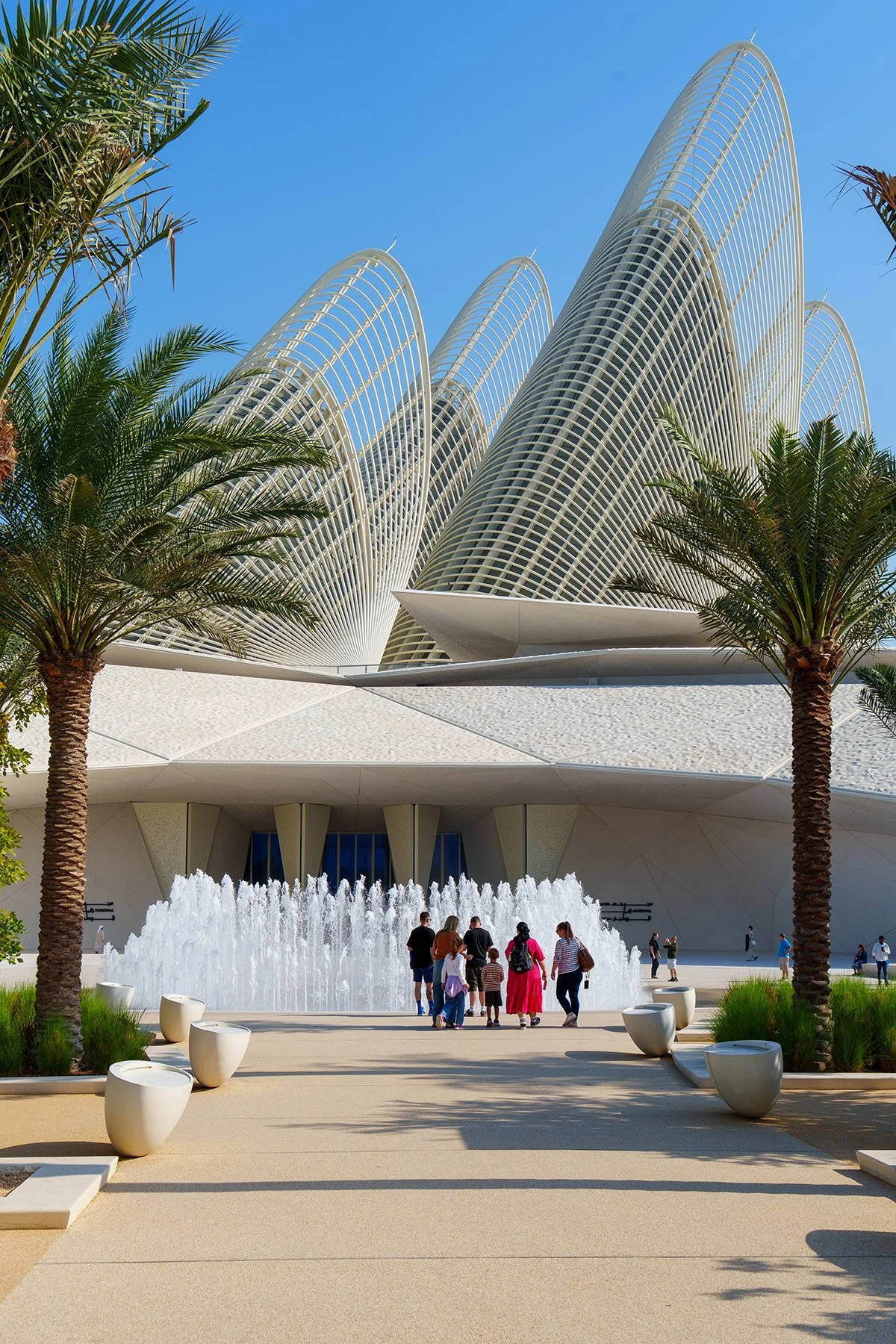
At ground level, the museum remains restrained. The massing is largely horizontal, reinforcing a sense of solidity and permanence. Materials are robust and understated, responding well to the intense daylight without drawing attention to themselves. The building does not seek visual complexity; instead, it relies on proportion, repetition, and clarity.
The finishes are dominated by white concrete cast in situ made using locally sourced crushed marble. This material choice is deliberate and restrained. Its tone and texture are intended to mirror the pale sand of Saadiyat Island, allowing the building to sit quietly within its context rather than contrast sharply with it. In the intense daylight, the surfaces remain soft and matte, avoiding glare while reinforcing the building’s connection to the landscape.
Inside, circulation is direct and intuitive. Movement between galleries is calm and unforced, allowing the content to lead the experience. Light is carefully moderated, with transitions that help maintain orientation without distracting from the exhibitions. The architecture supports the narrative rather than competing with it. Circulation is straightforward, with transitions between spaces handled without unnecessary drama. Light is carefully managed, mostly indirect, filtered, and controlled to protect exhibits while maintaining a sense of orientation. There is a noticeable absence of architectural, visual noise. This is a museum designed to be occupied and understood over time, not rushed through.
The museum houses seven galleries dedicated to the history, culture, and landscape of the United Arab Emirates, as well as the life and legacy of Sheikh Zayed. These galleries are contained within suspended pods, separated from the outer envelope. This strategy allows the external architecture and environmental systems to operate independently from the controlled internal exhibition spaces, a clear and rational planning decision.
From an architectural perspective, Zayed National Museum is a reminder that clarity is often more powerful than complexity. It demonstrates that contemporary architecture in the Gulf can be modern, technically advanced, and culturally grounded without relying on exaggeration. It is a building that does its job quietly and confidently, and that, in itself, is a strong statement.
